
The Bretton Woods System
In July 1944, as World War II neared its end, 44 nations gathered in Bretton Woods, New Hampshire, to design a new global economic system. The result? The Bretton Woods Agreement—an ambitious framework that reshaped…
Published June 1, 2025 · 3 min read
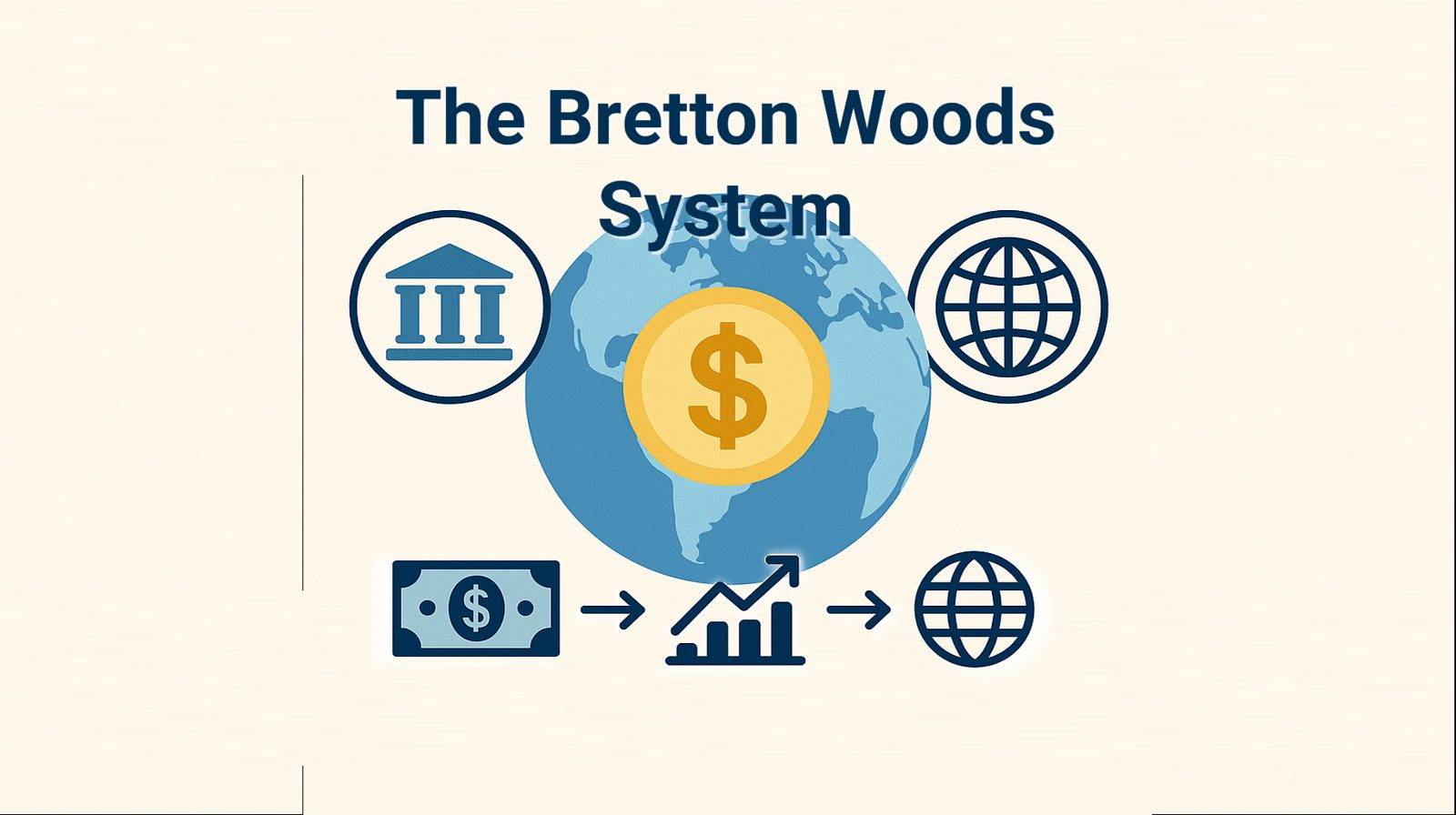
In July 1944, as World War II neared its end, 44 nations gathered in Bretton Woods, New Hampshire, to design a new global economic system. The result? The Bretton Woods Agreement—an ambitious framework that reshaped global finance and created the economic world we live in today.
The centerpiece of the system was a fixed exchange rate regime where currencies were pegged to the U.S. dollar, and the dollar was convertible to gold at $35 per ounce. This gave the dollar a central role in international finance and helped establish the U.S. as the world’s financial leader. Two new institutions were created: the International Monetary Fund (IMF) and the World Bank, which were designed to stabilize economies and rebuild war-torn nations.
Though the gold convertibility ended in 1971, the influence of Bretton Woods never disappeared. Today’s financial system still reflects its architecture:
-
The U.S. dollar remains the world’s reserve currency, involved in nearly 90% of foreign-exchange transactions.
-
Global lending and crisis management are still funneled through the IMF and World Bank.
-
Countries continue to depend on U.S. monetary policy, affecting inflation, interest rates, and capital flows worldwide.
So Why Does This Matter Today?
Because control over the global financial plumbing equals influence over geopolitics. Nations that rely on dollar-based trade are sensitive to U.S. sanctions, interest rate changes, and economic decisions. It’s why many countries—especially emerging powers—are exploring alternatives: bilateral trade agreements, digital currencies, and even gold-backed systems.
As investors and professionals in finance, understanding the legacy of Bretton Woods helps us see the big picture:
-
Why inflation and interest rates in the U.S. ripple across global markets.
-
How political tensions with China, Russia, or the Middle East have financial consequences.
-
Why global diversification and currency awareness are more important than ever.
How the System Worked
Under Bretton Woods, the U.S. dollar was tied to gold at a fixed price of $35 per ounce, and other major currencies were pegged to the dollar at fixed exchange rates. Foreign governments could exchange their dollars for gold with the United States. This arrangement gave the world a stable framework for trade after the war, and it made the dollar the center of the global financial system. The conference also created the International Monetary Fund and what became the World Bank.
Why It Ended
Over time, the system came under strain. As the United States spent heavily and other economies grew, more dollars circulated abroad than the U.S. could back with its gold reserves. In 1971, President Nixon suspended the convertibility of the dollar into gold, and within a few years, the world shifted to floating exchange rates, where currency values are set largely by markets. That is the system we still use today, and the dollar has remained the world’s main reserve currency.
Final Thought
The Bretton Woods system may have ended formally, but its impact remains embedded in the foundations of the global economy. Staying informed about its influence helps us make smarter investment decisions in a rapidly shifting world.