
How to Invest Through Wild Market Swings
Stocks have made some of their sharpest moves in years. Here is what history shows about trading those swings, or sitting through them.
Published November 9, 2026 · 4 min read
The past few trading days have been a reminder of how quickly markets can move. On Thursday, November 5, the S&P 500 fell about 4.4%, its worst day since April 2025, and the Nasdaq 100 dropped about 6.4%. The Cboe Volatility Index, often called the market’s “fear gauge,” jumped about 70% in a single session, the third-largest one-day increase since 1990.
Then the market turned just as sharply the other way. On Monday, November 9, the S&P 500 rose 2.35%, the Dow Jones Industrial Average gained more than 1,100 points, and the Nasdaq Composite advanced 2.74%. It was the Dow’s third swing of at least 1,000 points in four trading days, the most concentrated cluster of moves that large since the start of the pandemic lockdowns in 2020. Those swings followed the midterm elections and a sharp drop in some of the market’s largest technology stocks, then a rebound as oil prices fell.
Swings like these are uncomfortable. They also tempt people to start trading: sell after a drop to “stop the bleeding,” or jump back in after a rally so they do not miss the recovery. History is fairly clear about how that usually works out.
Why the Best Days Are So Easy to Miss
The market’s strongest days often arrive in the middle of its weakest stretches, not after the dust has settled.
In the spring of 2025, the S&P 500 fell nearly 19%. The best single day of that entire year, April 9, came right in the middle of that decline, when the index rose about 9.5%. According to data compiled by Ned Davis Research and Hartford Funds, an investor who stayed invested for all of 2025 earned 17.88%. Missing only that one day would have cut the year’s return to 7.64%. Missing the four best days would have turned a strong year into a slight loss.
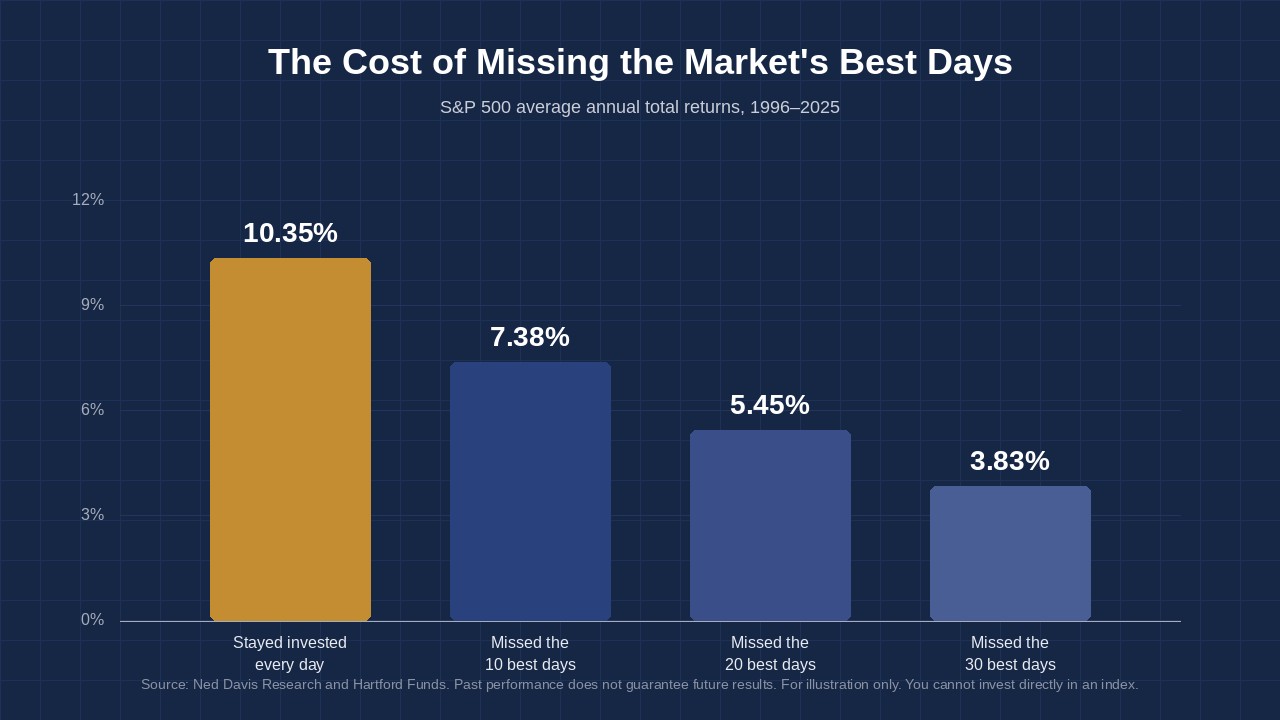
That is not a one-year quirk. From 1996 through 2025, the S&P 500 returned 10.35% a year, on average, for an investor who stayed invested every trading day. Missing only the 10 best days over those three decades reduced that average to 7.38%. Missing the 20 best days reduced it to 5.45%, and missing the 30 best days reduced it to 3.83%.
A J.P. Morgan Asset Management study of the S&P 500 from 2003 through 2022 found a similar pattern. $10,000 left invested for the full period would have grown to $64,844, an average annual return of 9.8%. Missing the 10 best days would have left that same investment at $29,708, or 5.6% a year. Over those 20 years, seven of the 10 best days occurred while the market was already in a decline.
The lesson is straightforward. An investor who sells after a sharp drop often locks in the loss and then misses the rebound that historically tends to follow. You do not have to miss many of those days for the damage to compound. Past returns do not guarantee future results, but this pattern has shown up across many different periods.
Trading Feels Like Control. It Usually Is Not.
Trying to trade volatility is appealing because it feels active. If prices are lurching up and down, doing nothing can feel reckless. In practice, successful market timing requires two correct decisions, not one: when to get out, and when to get back in. Getting either one wrong can cost more than the decline you were trying to avoid.
DALBAR, which has studied mutual fund investor behavior for decades, consistently finds that the average equity investor earns less than the market itself. In 2024, for example, the S&P 500 returned 25.02%, while the average equity investor earned 16.54%. The gap is largely a story of timing: money tends to flow in after markets have risen and flow out after they have fallen.
This does not mean no one should ever sell a stock, or that a portfolio should never be changed. It means that reacting to a few wild sessions is a poor substitute for a plan.
A Better Way to Handle the Swings
A solid approach during volatile markets is usually less about trading and more about preparation:
- Know what the money is for. Funds you will need in the next year or two generally do not belong in stocks. Money earmarked for long-term goals has time to recover from declines, which is why it can be invested more aggressively in the first place.
- Rebalance, don’t overhaul. If a sharp move has knocked your mix of stocks and bonds off its target, a disciplined rebalance can bring it back. That is the opposite of abandoning the plan.
- Keep contributing if you can. Regular investments, including contributions to a workplace retirement plan, automatically buy more shares when prices are lower and fewer when they are higher.
- Limit how often you look. Checking an account after every swing raises the odds of making a decision you would not make in a calmer moment.
Volatility is the price investors have historically paid for the higher long-term returns stocks have delivered. You cannot have one without the other. The investors who have been rewarded are generally the ones who stayed invested through both.
No one can tell you whether this week’s swings will settle down or continue. Forecasts in either direction have a poor record. What you can control is whether your plan can handle a range of outcomes: cash for near-term needs, a mix of investments that matches your timeline, and the discipline not to let a few loud days undo years of work.